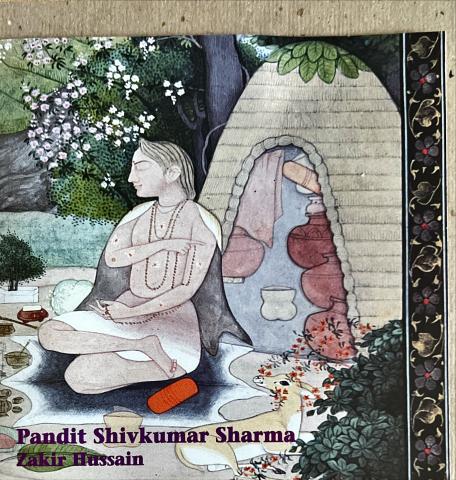


About Santoor - Raga Rageshri
Santoor – Raga Rageshri is a studio album in the Hindustani classical tradition released on January 1, 1993. The recording features Shivkumar Sharma on santoor and Zakir Hussain on tabla. The album presents a single raga performance structured across four tracks that follow the conventional progression of alap, jor, jhala, and gat compositions.
Shivkumar Sharma performs the primary melodic role on the santoor, a hammered dulcimer adapted for Indian classical music. Zakir Hussain accompanies on the tabla, providing rhythmic support and improvisational interplay. The album opens with Alap-Jor-Jhala, an unmetered exploration of Raga Rageshri that establishes the raga’s melodic framework. The subsequent tracks introduce rhythmic cycles: Slow Gat employs a vilambit (slow) tempo, Madhya Gat transitions to a madhya (medium) pace, and Drut Gat concludes with a drut (fast) tempo.
The release format and label remain undocumented in available sources. The performance adheres to the Khayal-influenced instrumental style characteristic of Sharma’s work, with Hussain’s tabla accompaniment reflecting the Farrukhabad and Punjab gharanas. Raga Rageshri, a night raga associated with the Kafi thaat, serves as the compositional foundation for all tracks.
Notable aspects of the recording include Sharma’s use of meend (glissando) and gamak (ornamentation) techniques on the santoor, while Hussain’s tabla playing incorporates complex layakari (rhythmic variation) and relas (accelerating passages). The album exemplifies the jugalbandi (duet) format within a single-instrument context, emphasizing spontaneous interaction between melody and percussion.
No additional production credits, alternate editions, or reissue details are confirmed. The recording date and studio location are not specified in public records.