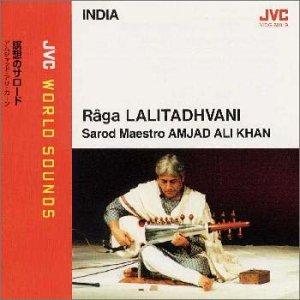
About Raga Lalitadhvani
Raga Lalitadhvani is a studio album by Indian classical sarod maestro Ustad Amjad Ali Khan. The recording features a solo performance in the raga Lalitadhvani, a rare and intricate raga associated with the late-night raag tradition of Hindustani classical music. Khan composed and performed the album in a conventional dhrupad-ang style, emphasizing deep alap exploration followed by rhythmic development.
Khan released the album on March 3, 1998 under an unspecified label. The primary format was a compact disc (CD), distributed as part of his broader discography during the late 1990s. The recording captures a live-to-tape session without overdubs, adhering to the improvisational ethos of classical Indian performance.
The album consists of two tracks. The first, Raga Lalitadhvani: Alap-Jod-Jhala, spans an extended unmetered section where Khan develops the raga’s melodic contours through gradual elaboration. The second track, Raga Lalitadhvani: Gat in Tintal, introduces a fixed composition set to a 16-beat tintal cycle, accompanied by tanpura drone and tabla. The performer’s name for the accompanying tabla artist remains undocumented in available sources.
Khan’s interpretation of Lalitadhvani employs the shuddha dhaivat (natural sixth) and komal gandhar (flattened third), characteristic of the raga’s structural framework. The recording exemplifies his signature sarod technique, marked by precise meend (glissando) and resonant stroke articulation. No commercial reissues or alternate editions of this album have been confirmed as of the latest available records.
The release date coincides with Khan’s broader international tours in 1998, though specific promotional events tied to this album are not documented. Critical reception from the period is likewise unarchived, limiting contextual analysis of its initial impact. The album remains a reference for students of the Seniya-Maihar gharana, the stylistic lineage Khan represents.