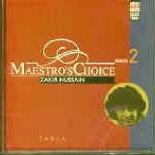


About Maestro's Choice - Zakir Hussain
Maestro’s Choice – Zakir Hussain is a collaborative studio album by tabla virtuoso Zakir Hussain and sarangi maestro Ustad Sultan Khan. The recording features a duet performance rooted in the Hindustani classical tradition. Moments Music released the album in 1995 on CD format.
The album comprises two extended improvisational tracks. Ektala and Teentala serve as the centerpieces, each exploring rhythmic cycles fundamental to North Indian classical music. The performances emphasize the interplay between Hussain’s intricate tabla patterns and Khan’s melodic sarangi phrasing. The recording captures a live-studio aesthetic, preserving the spontaneity of the artists’ interaction.
Zakir Hussain’s contribution highlights his mastery of the Punjab gharana tabla style, marked by technical precision and dynamic control. Sultan Khan’s sarangi playing incorporates the Indore gharana vocal tradition, blending instrumental dexterity with expressive microtonal inflections. The album’s production maintains minimal post-processing, retaining the acoustic clarity of the instruments.
The release date aligns with the broader mid-1990s revival of interest in fusion and pure classical recordings within Indian audiences. While specific sales figures or chart performances remain undocumented, the album received recognition among connoisseurs for its adherence to traditional jugalbandi (duet) conventions. No additional musicians or composers are credited on the recording. The liner notes, where included, provide contextual commentary on the raga and tala structures employed.
Further details regarding the recording location, session dates, or alternate editions are not publicly verified. The album stands as a representative work of the era’s classical collaborations, emphasizing the dialogue between percussion and melody in an unaccompanied setting.